Ever wonder what transforms flower petals, tree bark, and chemical compounds into the elegant bottle sitting on your dresser? The perfume-making process combines ancient extraction techniques with modern chemistry to capture scents that define personal style and evoke powerful memories.
The Raw Materials Behind Every Fragrance
Creating perfumes starts with gathering ingredients from around the world. According to the International Fragrance Association, manufacturers use over 3,000 different raw materials in modern perfume production.
Natural ingredients come from plants, flowers, fruits, woods, and animal sources. Rose petals from Grasse, France, provide floral sweetness. Sandalwood from India offers warm, woody notes. Citrus peels from Italy contribute fresh, zesty aromas. Vanilla pods from Madagascar add creamy sweetness.
Synthetic ingredients now make up roughly 80% of modern perfumes. Chemists create these compounds in laboratories to replicate natural scents or invent entirely new aromas. Synthetics offer consistency, affordability, and sustainability compared to rare natural materials.
The perfume industry sources materials from specific regions known for quality. Bulgarian rose oil costs around $6,000 per kilogram due to labor-intensive harvesting. One kilogram requires approximately 4,000 kilograms of rose petals.
Essential Extraction Methods That Capture Scent
Perfume makers use several techniques to extract aromatic compounds from raw materials. Each method suits different ingredient types and produces distinct results.
Steam Distillation Process
Steam distillation remains the most common extraction method for flowers, leaves, and stems. According to the U.S. Food and Drug Administration, this process involves passing steam through plant materials to release essential oils.
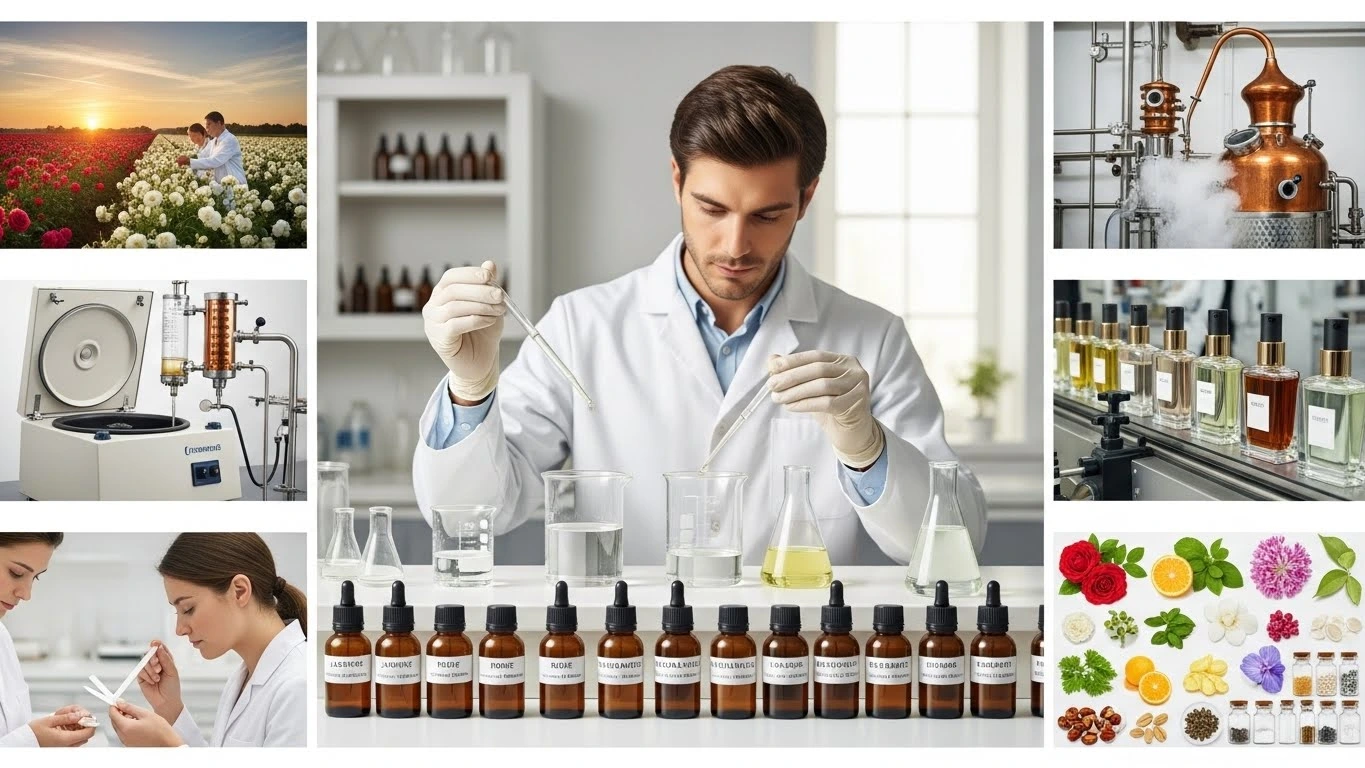
Here’s how it works: Workers place plant materials in a large still. Steam passes through, heating the materials and causing aromatic molecules to evaporate. The steam carries these molecules through a cooling tube. As the mixture cools, it separates into water and essential oil. Manufacturers collect the oil floating on top.
Lavender, peppermint, and eucalyptus respond well to steam distillation. The process takes 30 minutes to several hours depending on the material. This technique preserves the natural scent profile while removing impurities.
Solvent Extraction Technique
Delicate flowers like jasmine and tuberose cannot withstand steam heat. Solvent extraction offers a gentler alternative for these fragile materials.
This method uses chemical solvents like hexane to dissolve aromatic compounds. Workers soak flower petals in the solvent, which absorbs the fragrance molecules. After filtering out plant material, they evaporate the solvent, leaving behind a waxy substance called “concrete.”
Manufacturers then wash the concrete with alcohol to separate the pure aromatic essence, known as “absolute.” Jasmine absolute contains the most concentrated form of the flower’s scent. Just one drop can perfume an entire bottle.
Cold Press Expression
Citrus fruits yield their oils through cold pressing, a mechanical process requiring no heat or chemicals. This method originated in Italy centuries ago and continues today for lemon, orange, bergamot, and grapefruit oils.
Machines press the fruit peels to release oil from tiny sacs just beneath the surface. The resulting liquid contains both essential oil and fruit juice. Centrifuges then separate the oil from water-based components. Cold-pressed citrus oils smell bright, fresh, and true to the original fruit.
Modern CO2 Extraction
Supercritical CO2 extraction represents the newest technology in perfume manufacturing. The Environmental Protection Agency recognizes this method as environmentally friendly because it uses carbon dioxide instead of harsh chemicals.
Under high pressure, CO2 becomes “supercritical” – acting like both a liquid and gas. In this state, it penetrates plant materials and dissolves aromatic compounds. When pressure returns to normal, the CO2 evaporates completely, leaving pure extract behind.
This technique captures delicate scents that traditional methods might damage. It produces clean extracts without solvent residues. However, the equipment costs millions of dollars, making it expensive for small producers.
The Art and Science of Blending Fragrances
Once perfumers have their raw materials, the real creativity begins. Master perfumers, also called “noses,” spend 7-10 years training to identify and combine thousands of scent ingredients.
Understanding Fragrance Structure
Every perfume follows a three-layer structure that unfolds over time:
Top notes appear immediately after spraying. These light, volatile molecules evaporate within 15-30 minutes. Citrus oils, light fruits, and herbs typically form top notes. They create the first impression and draw you into the fragrance.
Middle notes emerge as top notes fade, usually within 30 minutes to 2 hours. Also called “heart notes,” they form the perfume’s character. Floral oils, spices, and green scents often occupy this layer. Middle notes last 2-4 hours on skin.
Base notes provide depth and longevity, appearing 2-4 hours after application. Heavy molecules like vanilla, amber, musk, and woody oils anchor the composition. These notes can linger 6-24 hours depending on concentration.
The Blending Process
Perfumers start by creating a formula that lists every ingredient and its exact proportion. A single perfume might contain 30-80 different components. Each ingredient appears in specific percentages, measured in drops or grams.
The perfumer combines ingredients in a large vessel, usually starting with base notes, then adding middle notes, and finally top notes. They stir the mixture thoroughly to ensure even distribution. This initial blend, called the “concentrate,” contains all aromatic materials.
Next, they dilute the concentrate with alcohol. Different perfume strengths use varying alcohol ratios:
- Parfum (perfume extract): 20-30% concentrate
- Eau de Parfum: 15-20% concentrate
- Eau de Toilette: 5-15% concentrate
- Eau de Cologne: 2-4% concentrate
After blending, the mixture undergoes “maceration” – a resting period lasting weeks to months. During maceration, molecules interact and harmonize. The scent develops depth and smoothness impossible in fresh mixtures.
Quality Control and Adjustment
Perfumers test their creations at multiple stages. They smell the blend on paper strips, on skin, and after various time intervals. Temperature and humidity affect scent perception, so testing happens in controlled environments.
If the formula needs adjustment, perfumers add tiny amounts of specific ingredients. Sometimes just one drop changes the entire character. They document every modification to maintain consistency across production batches.
Gas chromatography machines analyze the chemical composition of each batch. This technology, explained by the National Institute of Standards and Technology, ensures every bottle contains the exact formula. Computers compare new batches against the original standard, identifying any deviations.
From Formula to Finished Product
Once perfumers perfect the formula, manufacturing begins on a larger scale.
Large-Scale Production
Industrial mixers blend ingredients in quantities ranging from 100 to 10,000 liters. Manufacturers measure ingredients precisely using calibrated equipment. Even small measurement errors could ruin an entire batch worth thousands of dollars.
The mixture undergoes filtration to remove any particles or cloudiness. Some perfumes pass through filters multiple times until perfectly clear. This step prevents sediment from forming in bottles over time.
Chilling and Stabilization
Many perfumes undergo chilling, a process where manufacturers cool the liquid to near-freezing temperatures for 24-48 hours. This causes certain compounds to solidify and separate, allowing removal through filtration.
Chilling prevents cloudiness when consumers store perfumes in cool places. It also improves stability, helping fragrances maintain their scent profile for 3-5 years.
Bottling and Packaging
Automated filling machines pour perfume into bottles at rates reaching 400 bottles per minute. Sensors ensure each bottle receives the exact amount, typically measured to within 0.1 milliliters.
Crimping machines attach spray mechanisms or caps with precise pressure. Too loose and the perfume evaporates; too tight and the bottle might crack. Quality control workers inspect samples from every production run.
Labels, boxes, and decorative elements complete the packaging. Luxury brands often hand-finish certain details, while mass-market perfumes rely entirely on automation.
Safety Testing and Regulations
Before reaching stores, perfumes undergo extensive safety testing. The International Fragrance Association sets global standards that manufacturers must follow.
Toxicologists test ingredients for skin irritation, allergic reactions, and photosensitivity. Any compound showing problems faces restrictions or bans. The European Union maintains the strictest regulations, prohibiting over 1,300 substances in cosmetics and perfumes.
Manufacturers must list 26 common allergens on labels if present above certain thresholds. These include linalool, limonene, and geraniol – naturally occurring in many essential oils.
Stability testing exposes perfumes to various temperatures, light conditions, and time periods. Products must remain safe and maintain quality for their intended shelf life, typically 36 months unopened.
How Long the Process Takes
Creating a new perfume from concept to market usually takes 1-3 years. The perfumer might spend 6-12 months developing the formula alone, testing hundreds of variations.
Safety testing requires several months as laboratories conduct various studies. Manufacturing setup, including ordering bottles and packaging materials, adds more time.
Celebrity and designer perfumes often follow shorter timelines of 6-12 months because brands push for quick market entry. However, prestigious perfume houses developing original artistic creations might spend 3-5 years perfecting a single fragrance.
Why Perfumes Smell Different on Everyone
Your skin chemistry significantly affects how perfumes smell on you. Factors include skin pH, natural oils, diet, medications, and hormones.
Dry skin absorbs perfume quickly, making scents fade faster. Oily skin holds fragrance molecules longer, sometimes intensifying certain notes. This explains why the same perfume smells unique on different people.
Body temperature also matters. Warm areas like wrists, neck, and behind ears project scent more strongly. Perfumers recommend applying fragrance to pulse points where blood vessels sit close to skin surface.
The Future of Perfume Making
New technologies continue transforming perfume creation. Headspace technology captures the scent of living flowers without picking them. Special equipment analyzes aromatic molecules in the air surrounding a blooming flower, then chemists recreate that exact profile synthetically.
Artificial intelligence now helps perfumers predict how ingredients will interact. Computer programs analyze thousands of successful formulas to suggest new combinations. This speeds up development while maintaining creativity.
Biotechnology offers sustainable alternatives to rare natural ingredients. Scientists engineer yeast or bacteria to produce specific aromatic compounds through fermentation. This reduces environmental impact while ensuring supply consistency.
Conclusion
The journey from raw botanical materials to finished fragrance involves sophisticated extraction methods, precise blending techniques, and rigorous quality control. Understanding how perfumes are made reveals the scientific expertise and artistic skill behind every spray. Next time you apply your favorite scent, you’ll appreciate the complex process that captured those aromatic molecules in a bottle.